Everything we call a ghost comes from inside. This ghost train has no exit, because it never had an entrance.
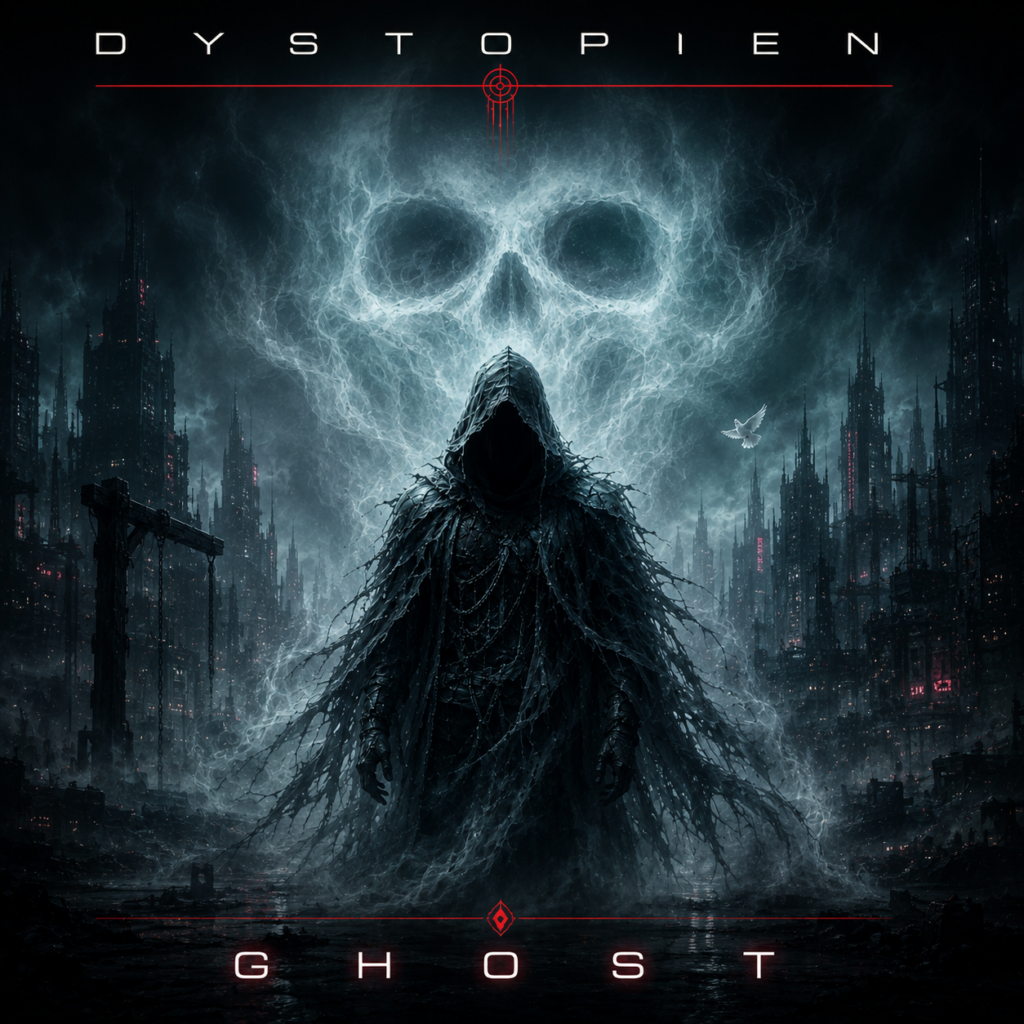
GHOST is the new album from Dystopien Sounds, and it’s an album about ghosts that doesn’t believe in ghosts. Thirteen tracks, thirteen spirits — and in every single one, the lyrics reveal that the haunting comes from the human being, not from beyond. The demon, the medium, the succubus, the incubus, the poltergeist — every one of them turns out to be projection, self-deception, the repressed thing that comes back.
The music is produced with AI assistance; every lyric and concept is written by Dystopien Sounds. The vision behind it is cyberpunk, with stylistic elements from Shadowrun and other pop-culture references — but because there’s real literary knowledge underneath the lyrics, the classics keep bleeding through. Oscar Wilde next to 50 Shades, Agatha Christie next to Dürrenmatt, the Bible next to a horror movie. The titles are lyrically layered, often built like small riddles — which is exactly why every single one gets its own explanation here.
01 Mr. X
(Synthpop / Coldwave / Spy Noir)
The opener arrives as a cool spy piece. Mr. X is the double agent working for two states at once and existing for neither — the invisible man who haunts every system without ever showing a face. The name nods to the classic figure of the unseen fugitive, chased across an entire city and never caught. The album’s first ghost is the one who makes himself invisible between every front line. A door-opener, elegant and cold, that states the theme before things get darker.
02 I See Dumb People
(Coldwave / Punk)
The title flips the most famous line from The Sixth Sense. “I see dead people” becomes “I see dumb people,” and the punchline lands the same way. The people it’s about don’t know it about themselves — just like the dead in the film don’t know they’re dead. The track deals with conformity, conspiracy belief, and the overconfidence psychology calls the Dunning-Kruger effect, named in the lyrics as “Mount Stupid.” A whispered child’s voice frames the song and delivers the diagnosis: people hear and see exactly what they want to hear and see. The song deliberately doesn’t aim at either political side — it aims at a human weakness. The ghost here is stupidity itself, a haunting you see everywhere except in yourself.
03 Ghost Rocket (Skeleton Remix)
(Country / EBM)
The album’s satirical spearhead. Country collides with hard electronics — a skeleton cowboy rides a burning rocket while the money burns up in orbit. The target is the grandiosity of the space race and a stock-market logic that turns the planet itself into merchandise, summed up in the hook about selling Earth once you know its price. The ghost here is capital itself, an undead cowboy of the market. The humor is deliberate — it’s the trojan horse that gets the political point past the listener’s defenses. Written on the day of SpaceX’s IPO. Already released as a standalone single.
04 His Tongue Is On Fire
(Industrial Gospel / Dark Pop)
A Pentecostal satire that risks a bold theological twist. The track plays on the double meaning of “tongues of fire” — the biblical flame tongues of the Pentecost miracle and the very physical kind. Its core argument is sharp: if the Pentecost miracle undoes the language-confusion curse of Babel, then Babel was a mistake God later had to correct himself. A breathy female voice stands for the flesh; an ironic narrator stands for the theology. Sacred and physical become indistinguishable, and that’s exactly the blasphemous joke. The nod to the pop-culture original here is meant as a tribute, not an attempt to mock the source — the original remains, and stays, exceptional.
05 50
(Darkwave / Gregorian Shadow)
The most densely layered title on the album. “50” stacks five references on top of each other: 50 Shades of Grey, Oscar Wilde’s Dorian Gray — whose portrait ages in his place — and the gray, celibate priest who outsources his repressed desire into an invented incubus. The lyrics quote Wilde directly, including his line that experience is merely the name people give to their mistakes, and turn it into an indictment of religious control over the body. The demon the priest believes he sees is only his own reflection. Over a Gregorian echo, sin becomes a question of projection. The incubus doesn’t come from outside. It never did. And maybe that’s reason enough to check whether any religion has the right to control someone’s sexuality in the first place — a right that, in some cases, ends up harming others too.
06 Ouija
(Coldwave / Séance)
A track about ideomotor self-deception — the phenomenon where people unconsciously move the planchette themselves and still believe a spirit is doing it. Told from the perspective of a child raised on religious fear of evil, and precisely because of that fear, drawn toward calling the spirits. The bridge holds the core realization: there was never a demon in the board — the only force spelling out the words was the one asking the question. When asked if anyone’s there, the answer is: it was always just me. The faith that warned about the darkness is what taught where to go looking for it. And even so, these ghosts never really stay quiet.
07 The Invisible on the Orient Express
(Gothic Noir / Dark Cabaret / Industrial)
Agatha Christie’s most famous detective meets the one case he can’t solve, because the culprit isn’t a person — it’s a ghost made of hatred, arrogance, and cruelty, an invisible first-class passenger. Underneath, barely hidden, sits Friedrich Dürrenmatt’s The Visit — the story of a community that becomes collectively guilty while every individual washes their hands of it. A train-stakkato rhythm drives the track, and the twist is bitter: the investigator himself becomes a victim of the conspiracy, turned into a restless ghost who wails through the carriages ever after. Where everyone is guilty, the solution can no longer point to any one person. Timely, at moments perhaps personal, or at least political. But this is a familiar ghost — one that keeps getting chased down, again and again.
08 Lilly
(Darkwave / Coldwave Ballad)
The album’s ballad, and its saddest track. Lilly is a succubus, but one built entirely out of loneliness. A man dreams up a companion in the cold, gives her eyes, a name, a weight — until one night she’s really there, and all she does is take. The bridge’s realization is merciless: he built the demon out of his own pain, the loneliest and most sacred of all misunderstandings. The succubus isn’t evil breaking in from outside — she’s the shape you give your own despair. In the end, she still comes, on every lonely night — and there are many of those.
09 Which Witch Is Which?
(Dark Carnival / Cold Gothic)
The album’s theologically sharpest track, built on the Witch of Endor from the first Book of Samuel — the Bible’s only functioning act of necromancy, in a book that explicitly forbids necromancy. The lyrics tighten the logical trap: either the witch lied and the prophet never came, in which case scripture itself is telling a ghost story — or the dead man really did rise at the call of a banished woman, in which case everything ever preached about the grave was never true. And it’s the witch who shows mercy to the broken king, feeding him, while the God who was supposed to answer stays silent. Arguably the album’s one genuine ghost proves, simply by existing, that the sacred order doesn’t hold. The dogma has direct scriptural grounding here — because everything that exists would already have to stop existing if even a fraction of it were true. A bit of source-text research, incidentally, checks out.
10 Vertical Ghosttown
(Industrial / Cyberpunk)
The track that goes deepest into cyberpunk aesthetics. The vertical ghost town is the emptied-out megastructure of the big corporations — the skyscraper as tombstone, the hollowed-out structure the people have vanished from. This is where the dystopian core of the album’s title shows most directly. The ghost here is the outcast, the one dropped by the system, the one made invisible. An economy that builds entire habitats and then depopulates them leaves ghosts behind — people who used to be residents. This is resource extraction pursued to the bitter end. The corporations didn’t care, and even the megacorps’ own enforcers never managed to escape. The question the track leaves hanging: which side would you rather be standing on?
11 One Side Mirror
(Coldwave Ballad / Darkwave)
Ghosting as haunting, narcissism as a ghostly apparition. The track takes the image of the one-way mirror and turns it into the essence of a woman who sees only herself, while the other person looks in vain from the transparent side. The narrator eventually leaves her. The song closes on a French final line, meaning, roughly, that she still only ever sees herself. Not a supernatural ghost — a very human one. The disappearance of the other person from the sight of someone who only ever knows themselves.
12 Poltergeist
(Industrial / Noise)
At its core, “Poltergeist” is a personal song about anger as a secondary emotion — about rage that can grow out of grief, fear, and unprocessed pain when those feelings get suppressed for too long. Years of adapting and self-control let the anger grow, until it becomes a poltergeist: invisible at first, and recognizable only by what it sets moving around it. The song doesn’t describe a cathartic outburst — it describes the fear of the moment when the pent-up force can no longer be controlled. Music, horror, and pop-culture references become the language for something that had no language of its own for a long time. The poltergeist isn’t a monster and isn’t a revenge fantasy. It’s the thing that stayed quiet for too long, until the silence itself becomes the warning sign.
13 Two Coins
(Industrial Ballad)
The finale, and death itself. “Two Coins” invokes Charon, the ferryman across the river of the dead, on whose eyes two coins were laid by old custom. The track closes the album with a bitter realization: the temple was the ferryman all along. The institution that manages the crossing — and collects for it — is itself the one doing the ferrying. After twelve exposed ghosts, GHOST ends on the one that can’t be explained away, and even there finds no comfort in the afterlife — only the human being, and his price. And if you’re devout enough, you’ll find more than Greek mythology here — you’ll also understand what it means to drop two coins into the collection urn at the temple, exactly what kind of urn you get for it, and what price you’ve already paid for it, blasphemously speaking.
The Album As A Whole
GHOST is a ghost train that leaves you alone with yourself at the end. Thirteen ghosts, and almost none of them exist. The priest’s demon, the medium in the basement, the succubus made of loneliness, the poltergeist of repressed rage — they all come from inside. The one genuinely supernatural apparition on the album — the summoned prophet — proves, simply by appearing, that the sacred order doesn’t hold.
That’s the dystopian method, translated into music. GHOST uses the figure of the ghost to make visible what the present represses and hides. The fear we blame on demons, the anger we won’t admit to, the people who fall out of the system and become ghosts themselves. It takes away the comfortable excuse of the supernatural. No demon seduced us. No spirit is to blame. What we call a ghost is us.
The sound is dark, the references run from Wilde to Christie to Dürrenmatt to the Bible to horror cinema, and the message is as clear as it is uncomfortable. It’s haunted. But it’s haunted from within.
DYSTOPIEN: GHOST. Album by Dystopien Sounds, thirteen tracks, released 08/27/2026. All lyrics and concepts by Dystopien Sounds; produced with AI assistance. Released with music videos: “I See Dumb People,” “Ghost Rocket,” and “Vertical Ghosttown.”
Category: Music · Concept Album · Dark Electronic · Dystopien Sounds · dystopien.com