HARVEST
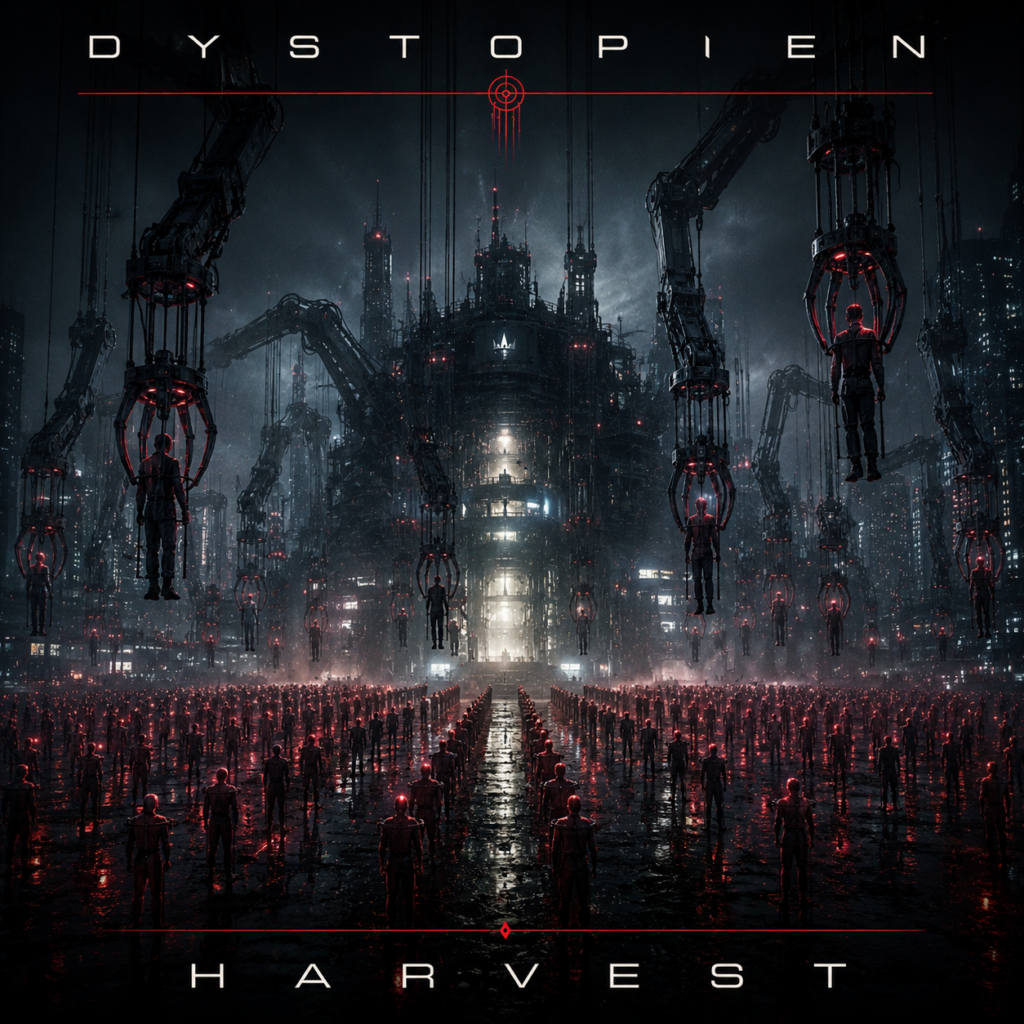
It begins with a circus. It ends with a clipboard.
HARVEST is the third concept album from dystopien.de — fourteen tracks built around a single image: the human being as crop. Something planted, grown, optimized, and eventually taken. Not by a stranger. By systems we built ourselves and then thanked for the privilege.
The album moves from spectacle to intimacy, from intimacy to routine, from routine to comfort, from comfort to intoxication, from intoxication to exposure, from exposure to a turning point that offers no easy comfort of its own, and finally to the coldest word in the English language: outcome.
Here is what every track says — and why.
The Concept
A harvest isn’t cruelty. That’s what makes it work. Nobody is dragged into a field at gunpoint. The field is comfortable. The field has electrolytes. The field has a golden cage with excellent lighting.
HARVEST takes the language of agriculture — planting, picking, farming, reaping, yield, outcome — and lays it over the systems that quietly live off human beings: the attention economy, the wellness industry, corporate resource extraction, organized religion, the justice system, the war machine. None of them announce themselves as harvesters. All of them use the language of care.
Shadowrun’s megacorps as the frame. The Bible — Noah, Jericho, Leviticus, the Reaper as death itself — as the recurring subtext. And underneath all of it, the same quiet question: if you built the cage yourself, and decorated it yourself, and you could leave — does it matter that you don’t want to?
“Brawndo” opens with a laugh. “Outcome” closes with silence.
01 Brawndo
The opener as circus. A barker in a warm, cultured voice welcomes the crowd to “the greatest show you never asked for,” interrupted again and again by a Joker’s laughter that slowly takes over the track entirely.
“Brawndo” is bread and circuses updated for the algorithm age — the treadmill, the arena, the vote sold as admission ticket. Underneath the carnival drums sits a very old Roman joke that never stopped being true: the harvest comes, and nobody wins, except the ones who built the wheel. Humor here isn’t relief. It’s the trojan horse the whole album rides in on.
Let’s get crazy. The machine keeps running. Nobody’s lazy.
02 Picking
The chaos stops. What’s left is a single breath, close-mic’d, almost too close. “Picking” is the other side of the harvest metaphor — not the machine that takes, but the crop that begs to be taken.
A voice that has optimized itself into nothing distinctive at all — softened every edge, curated every flaw away — just to be chosen. The track never raises its voice. It doesn’t need to. The quiet desperation of pick me, I’ll show you how is more unsettling than anything shouted on the track before it.
We are all standing in the same field, waiting for the harvest, too afraid not to yield.
03 Farming
No machine required. That’s the twist. “Farming” describes a self-optimization so complete that the farmer and the crop have become the same person — counting calories, counting miles, posting the workout, posting the meal, performing wellness for an audience that isn’t really watching.
The Matrix reference lands sideways: the red pill doesn’t pay the rent, and revolution costs more than you’ve spent. There’s no pod, no wire, no evil architect. You built the cage. You light the fire.
We already torture the treadmill. Mile by mile, ignoring the friction. No machines needed for this affliction. We farm ourselves into submission.
04 Golden Cage (Single)
Comfort as the most effective form of control ever designed. No bars, no guards — just a warm room, a curated feed, and just enough peace that leaving never quite makes it onto today’s list.
“Golden Cage” doesn’t accuse anyone. That’s what makes it land. The narrator knows exactly where the door is. He simply stopped looking for it, and he’s not entirely sure that was a mistake.
I’m not in chains — I’m decorated. I could leave. I think I could leave. I just don’t want to.
05 B.A.D. (Bioengineered Awakened Drugs)
A cabaret duet between a knowing woman and a naive man, over piano and an EBM pulse underneath. She pours the drink. He insists he’s choosing this freely. She, almost amused, corrects him.
“B.A.D.” is a track about who gets to classify a substance as medicine, vice, or crime — and who profits from the label either way. Cannabis locked away while tobacco had its say; the shaman’s brew called contraband while the brewery owns the land. Same molecule, different owner, different game.
B.A.D. This is bad. And the state is winning. While you think you had.
06 Drunken Savior (Single)
Noah, after the flood — the man who built the ark, held the line, and then, once the water receded, quietly fell apart with a cup in his hand. A story the source text tells and then never really looks at again.
“Drunken Savior” is a military-march chant built around one repeating question that institutions of every kind have always known how to answer: what shall we do with the drunken savior? Cover it up. Keep it sacred. Call it divine. The one who told the truth about what he saw gets punished harder than the one who fell.
Truth is a threat, we won’t repeat it. Bury it before the morning.
07 Stealing Elements
A corporate jingle, warm and almost friendly, sitting directly on top of a hard EBM kick. Megacorp explains, in the gentlest voice imaginable, how it will get you your daily bread — and how, once you close your eyes, it will start to steal.
Water first. Then air — carbon credits turning breath itself into a subscription. Then earth, traded like a stock until it becomes worthless and gets quietly written off. “Stealing Elements” escalates one element at a time until the mask finally slips.
We didn’t steal the planet — we just monetized it twice.
08 Eggheads are Hens Menstruations
The album’s punk detour — fast, mean, and deliberately gleeful about it. A biological joke aimed squarely at empty extremism: rage with nothing behind it, a fist without a mind, the same cycle repeating month after month with nothing new ever hatching.
It’s the ugliest, funniest track on the record, and it knows it. No metaphor is safe, no target is spared, and the chorus never apologizes for either.
They hate colours. But change colours. Concerned about the situation. Eggheads are hens menstruations.
09 Jericho Calling
Seven trumpet blasts, then silence, then the kick drum explodes. Joshua’s siege of Jericho — a starving city, walls that don’t need an army when the food runs out, and a God who calls the whole thing righteousness because the winning side got to write the story afterward.
“Jericho Calling” pulls the same architecture into the present: sieges that are legal and clean, courts that draw circles and assign blame, descendants who pay for battles they never chose. The righteous fall too, in the end — that was always part of the plan.
Jericho calling. The walls come down. Jericho calling. On the righteous ground.
10 Plant Yourself
The turning point — not resolution, but the first moment the album offers something to hold onto instead of something to survive. A single tree breaking in a storm is just a tree that breaks. A forest doesn’t ask you to agree. It asks you to show up.
“Plant Yourself” is the album’s one communal breath: rooted, grounded, refusing the isolation that every other track has been describing as freedom. It doesn’t promise safety. It promises that the alternative to roots is just drift, and drift without an anchor is just gone.
The forest stands when the single tree falls. But gangrene spreads when you don’t cut it out. Plant yourself — or get out.
11 Lord of the Harvest
The album’s epic center — Gregorian monks chanting Latin, a full orchestra, two voices arguing over who actually earned the right to reap. The Reaper’s voice is calm, convinced, ancient: the field is ready, the harvest demands what the harvest will take. The second voice doesn’t accept that as an answer.
“Lord of the Harvest” is the confrontation the whole album has been building toward: a creator who plants, walks away, and comes back only for the yield — and a chorus of the ones who did the actual growing, refusing to let absence be mistaken for authorship.
You built this world. Now look what you’ve done. Lord of nothing. Lord of the plan. Lord of everything, except what you began.
12 Soylent Green
A knife being sharpened, slow and rhythmic, under a calm, almost inviting voice. “Soylent Green” reframes the film’s twist as something we now do to ourselves voluntarily, one post at a time: profile picture, blood type, name, location, secrets, all offered up without a second thought.
Nobody forced the knife. Nobody forced the cut. The track’s coldest moment strips everything away to a single deep, spoken line — a whispered reminder that the harvest doesn’t ask permission, it just waits for you to open yourself up.
Soylent Green is people. It always was. You just didn’t ask, because nobody does.
13 Reaper
Death, demystified. Not Azrael, not Anubis, not Hades as tormentor — just the oldest character in every religion, finally given the microphone to explain that he was never the one selling fear. That was always someone else’s business model.
“Reaper” strips away heaven, hell, judgment, and karma in one doom-heavy monologue and replaces all of it with something almost gentler: an ending with no scale attached to it. No punishment. No reward. Just the period after the last word.
I am not punishment. I am not reward. I am not the darkness. I am just the end. Fullstop.
14 Outcome
The album’s coldest track, and its quietest. No anger left — just a pulse, a flat documentary voice, and a corporate mandate repeated until it stops meaning anything at all: maximize the outcome, maximize the yield, leave nothing on the table, leave nothing in the field.
Leviticus once said to leave the corners of the field for those who have nothing. “Outcome” notes, without raising its voice, that the system read that instruction and optimized the corners too.
Outcome maximised. Field cleared. Next.
The Album As A Whole
HARVEST is not an angry album, even when it sounds like one. It’s an exhausted one.
It doesn’t ask whether we’re being harvested — that much is obvious by track three. It asks whether the harvesting can even still be called an injustice once we’ve been convinced to run the machinery ourselves, decorate our own cage, and thank the field for the privilege of standing in it.
Noah with a cup in his hand. The dreamer who begs to be picked. The megacorp that steals water, then air, then earth, one gentle jingle at a time. The Reaper who never asked for any of the mythology built around him. And, once, briefly, in the middle of it all — a forest, asking you to stay rooted instead of drifting alone.
HARVEST asks: if the cage is comfortable, and you built it, and you could leave — was it ever really a cage?
There’s no reassuring answer. Just the field, cleared, and the next thing already growing.
HARVEST – dystopien.com. All tracks available on YouTube and most major streaming platforms.
Genre: EBM · Industrial · Coldwave · Dark Carnival · Punk · Doom · Orchestral · Cabaret Noir · dystopien.com