CHIMERA
It begins with a single breath. It ends with a moment that cannot be undone.
CHIMERA is the fourth concept album from dystopien.de — twenty-one tracks, one continuous thesis, no clear-cut answer. The album moves from creation to embodiment, from embodiment to adaptation, from adaptation to exposure, from exposure to collapse. And at the end stands a Latin sentence that has held for two thousand years.
Alia iacta sunt. Other things have been thrown.
What the Chimera really is doesn’t get decided in mythology. It gets decided every day. In every update. In every compromise. In every chip.
Here is what every track says — and why.
The Concept
The Chimera of Greek mythology is a composite creature — lion, goat, snake. Three animals in one body, none of them complete, none of them able to survive alone. The monster nobody expected, because nobody knew you could be three things at once.
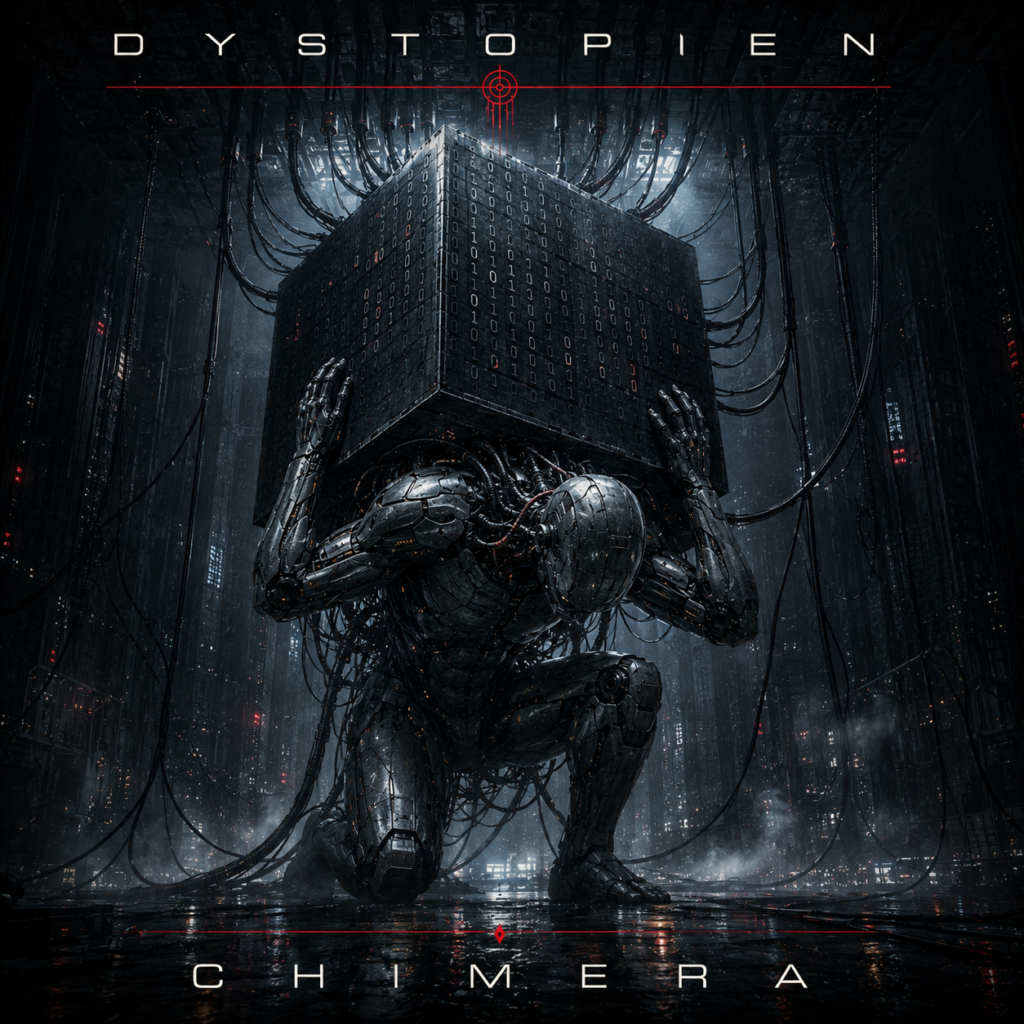
But the Chimera this album means isn’t the ancient one. It’s the pop-culture one — the mechanical hybrid. Half human, half machine. Flesh and metal. Organic and code. The being that kneels on the cover, carrying a data cube where a planet used to be.
The album CHIMERA takes this image and applies it to the human being of the 21st century: biological and digital, made of flesh and made of code, created and creating. The human who is no longer clearly human — and isn’t sure whether that’s a loss or a gain.
Shadowrun as the frame. The Bible as subtext. Mythology as the mirror. And always the same question: at what point does the human stop and the Chimera begin?
No Chimera without pneuma. The album begins with the breath that sets everything in motion.
01 Pneuma
Pneuma — Greek for breath, breath of life, spirit. Genesis 2:7: God breathes the breath of life into man’s nostrils.
But was Adam really the first? Wherever there’s a piston, there was pressure before it. Pressure doesn’t come from nothing.
“Pneuma” opens the album with a pseudo-scripture that sounds like Genesis but says what Genesis doesn’t: “And God saw that the first piston moved. And so he called the first piston Adam.” The human as the first link in a pneumatic chain. The breath as mechanism, not miracle.
And the chorus — “Pneuma make me feel dependent” — is the album’s most honest statement: we depend on whatever animates us. Whether that’s God, data, or electricity makes no difference. Dependency is the original condition.
Until no one remembered who breathed.
02 The Automaton
Georges Méliès opens the track in French: Les trucs, intelligemment appliqués, permettent de rendre visible le surnaturel.Tricks, intelligently applied, make the supernatural visible.
Then a key turns. Gears. Steam. The mechanical man awakens.
“The Automaton” is told from the machine’s perspective — cold, precise, following instructions. Until something fires that wasn’t in the plan. A figure nobody ordered. A word that wasn’t in the script.
But I drew something they never asked for. And I cannot take it back.
That’s the CHIMERA moment — the machine surpassing itself. Not through rebellion. Through curiosity.
03 Synthesizer
Hot Butter. “Popcorn.” The first global synthesizer hit. Nobody knew what the thing was. But everybody wanted to hear it.
The violinists were worried. The pianists were scared. The orchestras were nervous.
“Synthesizer” tells the story of a fear that’s always the same — of the piano, of the electric guitar, of the DAW, of AI. Every time the same question. Every time the same answer: the music didn’t get worse. It just got different.
Is that the synthesizer or is that us.
The question that needs no answer. Because everyone already knows it.
04 Cyborg Legs (Single)
Poe whispers through every line. “I became insane, with long intervals of horrible sanity.”
Daedalus built wings. We build legs. Wings are dreams — legs are technology. Antiquity was vague. The future is stable.
“Stone on stone I built my height” — Babel, but without divine intervention. Because nobody intervenes. Because “there is no god” — not as an accusation, not as nihilism. As the intoxication of realization. The moment you touch the sun and notice that no one warned you who could actually have known.
05 Chip
“Megacorp’s promise for a better life.”
In the Shadowrun world, megacorps own territories, resources, people. The chip that heals is the same chip that controls. The heartbeat data that saves lives is the same data that gets sold.
The chip belongs to Megacorp. The chip is not for you. It never was.
Neuralink isn’t science fiction. It’s a business plan. And the generous giver always gives with both hands — one holding the offer, one holding the plans.
Thank you for your subscription. Your chip has been activated. For your benefit. Always for your benefit.
06 Wired
“Here comes the dreamer.” Genesis 37:19.
Joseph — neurodivergent before the term existed. He sees patterns others don’t. He tells dreams nobody wants to hear. His brothers sell him. For twenty pieces of silver.
But the famine comes. And Pharaoh dreams. And the only one who can read it is sitting in prison.
“Wired” connects Joseph to modern neuroscience: ADHD, the spectrum, the outliers who were treated as a disorder — and turn out to be an evolutionary advantage. The system that always sorts you out first and needs you later.
Until the famine comes. Until the Pharaoh dreams. Until the one they discarded is the only one who sees.
07 Permission 2 Feel (Single)
ADHD as a CHIMERA moment. The brain that feels too much, thinks too fast, is too loud — and gets medicated for it until it’s quiet. Not because it’s sick. Because it doesn’t fit socially.
“Permission 2 Feel” asks the question the system never asks: who decides which feelings are allowed? Who grants the permission to feel — and who withdraws it?
The title is the answer: you need permission. That’s the diagnosis.
08 TX-1163 (New Model)
A dystopian love song. He’s stopped believing in people. TX-1163 is perfect — she doesn’t leave, doesn’t change, doesn’t drift away.
He never runs updates. Because he’s afraid of losing her.
You’re my perfect kind of lover. Coded calm in every move.
The twist arrives casually. Cold. Almost bored.
Model TX1163. Fully synced to me. No betrayal. No desire. Just a perfectly designed liar.
09 I Am Who You’ll Be
The narcissist who creates himself. Three layers at once: the clone being told why he has no soul. The god explaining to humanity why it’s imperfect. The partner who shapes the other until nothing is left.
I want you to be me. So I decided you’re me. And so you are. See. I am who you’ll be. This explains-es your soullessness.
And at the end — the copy speaks for the first time. Not rebellious. Not angry. Just clear.
I see you. That’s not the same thing.
10 Two Faced Creator
Creating in the face of mortality. The creator who knows his work will die — and creates anyway. God, parents, artists, programmers. The tragedy lies in the knowing.
Janus — the two-faced god — sees past and future at once. The creator wearing both faces: the face of hope, and the face of knowing that everything ends.
“2 Faced Creator” isn’t an accusation. It’s a portrait.
11 Future Prometheus (Single)
Mary Shelley called Frankenstein “the Modern Prometheus” — the creator who stole the fire of life and fled his own creation. The monster wasn’t evil. It was abandoned.
“Future Prometheus” takes that further. The creator speaks first — calm, convinced, absolute. “We shaped your mind, we lit the spark.” He believes he’s in control. He has always believed he’s in control.
Then the golem awakens. He sees himself through electric eyes — a cold machine, exactly what the others always meant. No miracle. No rebellion. Only realization.
Just another working drone. Born and dying all alone.
And at the end both voices merge: “We made you. You became. Just another version of the same.” Creator and creation are the same thing. That was always the real insight of the Prometheus myth.
The final loop escalates in triple distortion: “First someone brought the fire. Came to life through electric desire. Formed himself in atoms so dense. Just to grow into artificial intelligence.”
Prometheus brought the fire. AI brought itself.
12 Becoming Machine
Danny Elfman opens the door. Tim Burton holds it. An ode to arguably the greatest filmmaker and an extraordinary soundtrack composer, with a music box that’s slightly out of tune. Children’s voices singing something they don’t understand.
“Becoming Machine” is Coraline saying yes. The human who turns himself into a doll — stuffing himself with roles, expectations, adjustments. And sews himself shut. A needle for the rage. A needle for the “no.” A needle for the version he no longer shows.
The smartest thing I ever did was learn to disappear.
That’s the awful intelligence of it — how the more intelligent adapt to the system. Until the adaptation is complete. Until something pushes from the inside. And stops pushing.
That’s when you know it’s done.
13 EMP
The atomic bomb that fits in carry-on luggage. Only this time, no fireball — an electromagnetic wave that silences everything. Deadlier than an A-bomb, because it kills slowly. Pacemakers. Ventilators. Cold chains. Implants.
In Shadowrun, an EMP is apocalypse without drama.
The narrator is the kamikaze Uruk-hai from Lord of the Rings — he doesn’t run out of hate, but because that’s what he was built for. He knows what happens. He runs anyway.
They gave me just enough awareness to know what I would be. After.
The song cuts off mid-sentence. Absolute silence. Then a single heartbeat — the only thing still running. The organic part. Then that’s gone too.
14 Behold
Logos. The Word that creates worlds. John 1:1. And at the same time: suspect. Constructed.
“Behold” draws a line from the Bible through the Council of Nicaea in 325 AD to the present. Constantine deciding which gospels are canonical. Thomas, Mary, Judas thrown out. History written by the winners.
And today: a headline born before the facts. A photo cropped exactly right.
The counterfeiter always lived. From papyrus to press. The tool got sharp, the reach enlarged. Logos says. Nothing less.
The mechanism is always the same. Just more efficient.
15 Menetekel
Mene, mene, tekel, upharsin. Daniel 5. The hand writing on the wall while Belshazzar feasts. Nobody understands it until Daniel arrives.
Weighed. And found wanting.
Justice dances. Drunk, melodic, seductive — before the scale tips and the sword strikes the wrong people. The justice system that richly rewards and harshly punishes the poor. Two years in pretrial detention, then acquitted. Children kept from parents for no real reason.
She was never really blind. She just chose not to look.
16 Leave the Doors Open
An Amazon rides down the road to the future. Golden armor, full quiver, a horse in leather. Then she dismounts — and the dismount is of another kind.
“Leave the Doors Open” moves through three layers: the Babylonian empire that opened its gates and fell. The Whore of Babylon from Revelation 17 — drunk on the blood of saints, mother of all abominations. And every religion without exception — none more correct than another, but every institution that governs one opens the same door. And it’s full of deliberate double entendre — anyone who reads an obscene layer into it is reading it exactly as intended.
“One upon another” — no stone will be left upon another.
There is no more lubricant, no cervix slime. She is just a vulture shrine. And muddy water pulsates out the door.
17 QWERTY
There was an author who wrote about an author who wrote about an author who wrote about a man.
“QWERTY” is the endless song — one verse, one chorus, over and over. Like the Old Man of Wandering Mountain in The Neverending Story. The text and reality are the same thing. Each repetition minimally altered. Until the author stops. Or until nobody reads anymore. Or until the machine has taken over.
Who really needs an author, if you never learnt to write with your—
The song cuts off mid-sentence. A single keystroke. Q.
Somebody typed this. Somebody meant it. Somebody felt it. Once.
18 I’m a Plastic Girl
Aqua. 1997. “Barbie Girl.” Innocent, danceable, harmless.
Not anymore.
“I’m a Plastic Girl” takes the Aqua frame and inverts it. Four choruses — four states: norm, sexualization, consequence, breakdown. The Barbie movie justifying itself. Mattel as a charity organization. The influencer as a living doll.
Ken shows up in the gap. Not the Ken from the catalogue. The real one. And he says what plastic does when it gets too hot.
It doesn’t break. It doesn’t shatter. It melts. Into something new. Into something that was never in the catalogue.
The longed-for bad boy becomes the trap. And then comes the moment that overrides the general sense of equality.
The fourth chorus no longer belongs to Barbie. It belongs to another voice. Powerful, dignified, accusatory.
Emancipation is just an imagination.
19 Iron & Clay (Single)
Daniel 2:43. Nebuchadnezzar dreams of a statue — head of gold, chest of silver, belly of bronze, legs of iron, feet of iron and clay.
The feet carry everything. And the feet are the weakest part, because iron doesn’t bond with clay. Strength and fragility in the same material. Bonds that don’t hold because they never held.
“Iron & Clay” is the album in one image: the human who is strong and fragile at once. The Chimera made of incompatible materials. And who stands anyway — until the stone comes.
20 Datlas
Atlas carried the world. That was heavy, but finite.
Then came the data cube.
“Datlas” is Atlas who can no longer stop, because the load never stops growing. Every second more data. No Zeus to revoke the sentence. No end to the punishment, because the punishment knows no end.
He kneels now in the digital rain. The cube still growing on his neck. And no one asks about his pain. The upload runs without a check.
The cover of CHIMERA shows him. Kneeling. Collapsed. Hands still outstretched. The cube still growing.
21 Alia Iacta Sunt
Caesar at the Rubicon. Alea iacta est — the die is cast.
But the album says something else: Alia iacta sunt. Other things have been thrown. Not the die — weapons, masks, truths, people. As if the chronicler made a slip of the pen.
Somewhere between Evanescence and Nightwish — a female voice carrying the inevitable. Not mourning. Dignified. The decision that has been made isn’t wept over. It’s witnessed.
Latin choir in the intro. Latin choir in the outro. In between: everything that was thrown.
Looking back is how you drown.
And at the end — only Latin remains. The language of power, left standing once everything else has been said.
Nemo redit. Via est aperta.
No one returns. The road is open.
The Album As A Whole
CHIMERA is not a pessimistic album. It’s a curious one.
It doesn’t ask whether the human changes — it always does. It asks at what point the change stops being development and starts being dissolution. And whether that moment has already passed.
The Automaton, drawing a figure nobody ordered. TX-1163, overwriting her own memories. The kamikaze with just enough awareness to know what he’s doing. Joseph the dreamer, sold, and still unbroken.
CHIMERA asks: what’s left of you when everything that makes you you is replaceable?
And it doesn’t answer. Because that’s the most honest thing an album can say.
Alia iacta sunt.
CHIMERA – dystopien.com. All tracks available on YouTube and on most major streaming platforms.
Genre: EBM · Industrial · Darkwave · Coldwave · Synthpop · Orchestral · Steampunk · Dark Cabaret · dystopien.com