MUTATION
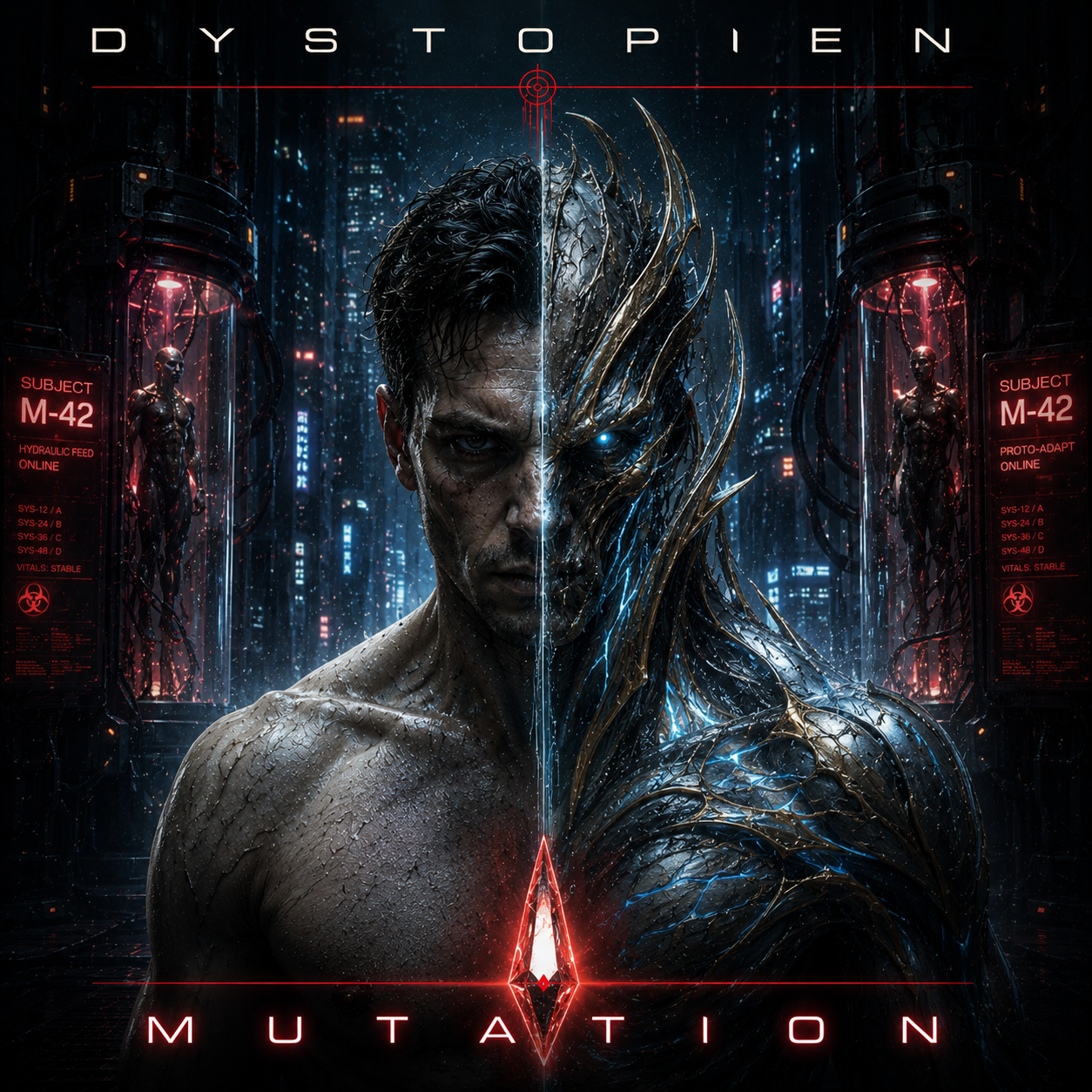
It begins with a Big Bang no one hears. It ends with a system that cannot be switched off.
MUTATION is the fifth concept album from dystopien.de — twenty-nine tracks, one core question, no reassuring answer. The album moves from creation to adaptation, from adaptation to camouflage, from camouflage to exposure, from exposure to takeover. And it asks the same question throughout: change — or perish. But does change save you? Or does it only preserve whatever is devouring you?
Mutation is not a term for progress. It’s a diagnosis.
Here is what every track says — and why.
The Concept
Mutation is the engine of evolution — and, at the same time, the thing we fear most. A mutation is not a plan. It’s an error that proves useful, or an error that dies. No will stands behind it, no intent, no morality. Only pressure, chance, and the cold question of whether the new thing survives.
MUTATION takes this biological principle and lays it over everything: over religion, which sells conformity as obedience. Over politics, which disguises camouflage as conviction. Over love, which deforms itself until nothing genuine remains. Over the human being, who changes because they have to — and no longer knows whether they’re growing or disappearing.
Shadowrun as the frame. The Bible as subtext. Evolutionary biology as the mirror. And always the double reading: the same adaptation that is liberation in “Metamorphosis” becomes infiltration in “Unplugged.” You see what you want to see.
“Genesis” opens with a god who leaves. “Unplugged” closes with a system that stays.
01 Genesis
Creation, told from the perspective of a god who simply leaves once the work is done. He says “Behold” — but no one is listening, least of all himself. He’s gone deaf to his own Big Bang.
“Genesis” turns the creation myth into its loneliest form: the creator calls out into a world that his call never reaches. The spirit hovering over the waters has already vanished again before any answer comes. And on the seventh day he doesn’t rest — he drifts off into a bar for lonely gods, into a book titled Being a God for Dummies.
The structure dissolves itself at the end, because God dissolves. No hard ending — just a fade into silence.
Hopefully he can hear much better after getting sober.
02 Gojira
Mutation as catastrophe. Godzilla — Gojira — isn’t an animal, but a consequence: the result of what humanity let into the water. Nature, mutating back what was done to it.
“Gojira” opens the album’s biological thread at full force. Here, mutation isn’t a quiet process of adaptation, but an impact. The repressed, returning at a scale that can no longer be ignored.
03 In Bed with a Bat
Dracula as mutation — the human who leaves the species behind and becomes something else. The bat as the threshold between worlds, carrier and transmitter at once.
“In Bed with a Bat” plays with a catchy surface over a dark core: a danceable piece about contagion, transformation, and the desire to shed one’s humanity. The bite as an update.
04 Camouflage
A love song that turns. A butterfly falls in love — and the partner turns out to be the bird hunting it. Your beak crushes my chest to fulfill the assemblage.
“Camouflage” layers three planes on top of each other: the personal (the narcissist who disguises himself until he strikes), the plane of creation, and the plane of metamorphosis. The rhymes are deliberately imperfect — only in the moment of destruction does the language suddenly turn clean. Green here is everything at once: insect blood, camouflage, the military.
05 Resting Bitch Sphynx
The Sphinx as a satisfied woman who has taken what she wanted and smiles about it afterward, unashamed. Sekhmet, the lion goddess, as a kindred spirit.
“Resting Bitch Sphynx” is Egyptian Gothic with a double bottom — the smile after satisfaction, the cold gaze of someone who no longer asks. Gulping down hate like drinks, waiting cold for the moment to harm.
06 Mimicry The Party
Political conformity as animal mimicry. The praying mantis turns red, the chameleon turquoise, the tiger no longer wears any camouflage at all, because it no longer needs to.
“Mimicry The Party” describes how the center changes color so as not to stand out — and how the open far right eventually abandons all camouflage entirely. Chimneys dirt is the reference you either hear or miss. The finale names what the mimicry conceals: political mimicry masks fucking racism as something good.
07 Conditional Love
Love with conditions isn’t love. “Conditional Love” tells of a relationship as mirror — the narrator exists only as a reflection of the other, has no substance of his own, is only what the other needs.
The twist: the narcissist needs the mirror too. Without reflection, he vanishes as well. Both trapped, both empty. Mirror me, or I can’t be.
08 Fruit Of Wisdom
Why would an all-powerful creator make wisdom dependent on a piece of fruit? “Fruit Of Wisdom” escalates this question step by step — up to the final one: how can a god create beings who bring more love into the world than he himself ever showed?
Dark Carnival with a seductive intro and a morbid core. Knowledge as forbidden fruit — and the temptation to pick it anyway.
09 Voices In The Storm
Three voices in the storm, Job as the frame. One voice gives up, one fights back, one raps its way through doubt. At the center stands a thought about paradoxical control: This is my free will. I decide when this ends. I decide to stay.
“Voices In The Storm” carries the album’s biggest energy — the force of a stadium anthem turned inward. The struggle between giving up and carrying on, played out as polyphony.
10 Metamorphosis
The album’s one bright moment. A utopia without negation — because utopia needs no complexity, dystopia does. Generations at one table, a lightness the album allows nowhere else.
“Metamorphosis” is adaptation as liberation — the same principle that becomes infiltration by the album’s end, shown here in its most beautiful form. A dream within a dream, a soft ending. The calm before the break.
11 Hypermutation
The hinge. A Scooter mock-up in which the chorus line “Hypermutation!” takes the place of “Hyper Hyper” — and the DJ shout-outs aren’t for clubs, but for evolutionary biologists: Darwin, Mendel, Watson and Crick, Jared Diamond, E.O. Wilson, Nick Bostrom.
“Hypermutation” tears everything open at the midpoint and separates the more accessible first half from the more complex second. It is so beautiful to see organisms collapse — collapse with your hands in the air! Humor and force in one. Darwin would have loved this. Be there, stay tuned, bye bye.
12 Superior
An arc from reggae to Combichrist. Begins as a spiritual prayer in a Gentleman-style groove — devout, uplifted — and tips over into an industrial scream.
“Superior” turns hierarchy absurd: Eight billion superiors, eight billion gods. If everyone is superior, no one is. The realization breaks into a scream halfway through the track. Give thanks for consciousness. We wasted it.
13 Inferior
The counterpart. Tell me how you feel if your leader wants you to kneel. Where “Superior” negotiates arrogance, “Inferior” negotiates submission — and the rage beneath it.
A rap bridge names the way out that shouldn’t have to be one: System restructure and equal rights would prevent to feel inferior. The reference to the high castle — while Superior sits in high castle — draws a line to Philip K. Dick.
14 Phenotype
Phenotype is what you see. Genotype is what you are. “Phenotype” exposes the racist gaze that reads only the surface and mistakes it for substance. You just want to see the outside — fucking stupid reminiscence.
The double-time rap bridge turns the tables: it briefly puts on the racist’s glasses and beats him with his own logic — whoever sorts by phenotype gets thrown out first. Then the mirror flips: See how that feels? That was your voice. Not mine. The Shadowrun layer (orc, troll, reptile skin) carries it into fiction. The difference was never there.
15 Devilution
Jekyll and Hyde, two voices layered until the line between them disappears. Victorian morality collapsing under its own corset. “Devilution” — devil, evolution, and devolution in one word.
The track builds from cultivated control to raw release and ends in the present: Seven billion Hydes now — when everyone is Hyde now, Hyde was right all along. Anomie not as collapse, but as the new normal. He thought he had discovered evil. He had only discovered himself.
16 Fucking Europe
Myth as economic critique. Zeus abducts Europa in the shape of a bull — and the bull remains, to this day, a symbol of economic hunger, of growth without restraint. The offspring, hidden in the labyrinth, is the mistake you lock away instead of looking at.
“Fucking Europe” links the myth’s assault to the present: The godlike bull is on the run — a wild bull, untamable, devouring state after state. Europe is already on her knees.
17 Circuit of Life
The Lion King, read politically. A Zulu choir opens with a translation meant as an accusation: “Once again, you’re voting for the Nazis. You haven’t learned a thing.” “Hakuna Matata” as political refusal — the carelessness of those who look away.
“Circuit of Life” lays the Disney myth under Hans Zimmer force and a cold thesis: The machine keeps turning with or without a single person. The circle of life as the circle of repetition. Stupid history had again begun.
18 Overmind
The Zerg swarm as a political image. One consciousness, many bodies — the dissolution of the individual into the collective. “Overmind” negotiates the temptation and the horror of total unity.
The mutation here is the surrender of the self: the “I” that vanishes into the swarm, because the survival of the whole no longer recognizes any single one. Continental politics in the language of StarCraft.
19 For Aiur
The Protoss answer to the swarm. Where “Overmind” is the collective without a self, “For Aiur” is the collective with honor — the Khala, the bond that shares consciousness without erasing the individual.
“For Aiur” is epic, almost sacred: the battle cry of a civilization defending its home. Two models of community, two tracks answering each other.
20 M-42
The cloned superman who, asked the great question of meaning, returns only a number: forty-two. “M-42” takes Douglas Adams at his word — the perfect answer that helps no one, because no one knows the question.
Mutation as optimization into a void: a being designed for perfection who, for that very reason, has nothing left to say. The answer without a question.
21 Awake-ned!
The Watchtower Society’s Awake! magazine meets Shadowrun’s goblinization. Matthew 5:11 opens — “Blessed are you when they persecute you” — and then the scream: AAAWAAAKE!
“Awake-ned!” layers three forms of awakening: those who celebrate persecution as confirmation and stay inside the system; the awakened, who develop real power and leave; the goblins, who never had a choice. Being different is no achievement. Nature forgot about their metamorphosis.
22 Talking Snakes
In the Garden of Eden, the first humans know only their own voices and one in the morning wind that’s supposed to be God. But a talking snake doesn’t surprise them at all — because they’ve never learned to question anything.
“Talking Snakes” sends an emcee, Dr. Aesculap, through the Bible’s serpent metaphors: from Eden to the bronze serpent in the desert that suddenly heals, to the staff of Moses. Today the snakes wear suits and speak with forked tongues — and our language quotes the Bible without noticing. Who designed the forked tongue? Next stop: Medina.
23 Judging Gay People
Leviticus as demographic policy. “Judging Gay People” reads the Old Testament prohibition not as divine judgment, but as what it historically was: the arithmetic of a society without doctors and with high child mortality, one that needed every body for reproduction. Moses needed babies.
Dark Carnival with a dry punchline: homosexual behavior — observed in over 450 species. Homophobia — observed in exactly one. And the question of a Jesus with twelve close friends, about whom scripture stays silent. You know the question.
24 Shapeshifting Loki
A Gothic waltz in three-four time — the meter that keeps turning and never stands still, like the shapeshifter himself. Loki as rebel and seducer: Prometheus, devil, phantom, the Count von Krolock, all in one figure.
“Shapeshifting Loki” tells the tragedy of someone who could change the world — expose the father as a liar — but instead transforms into whatever shape love demands. Whoever becomes everything for everyone can never be loved as himself. To be at home in every form is to be forever lost. The waltz breaks off mid-beat.
25 Chrysalis
Genesis 1:2 opens in Hebrew: “And the earth was without form, and void.” The tohu wa-bohu — chaos before form — as the state before an encounter. Before I met you I felt without form and void.
“Chrysalis” carries three layers: the personal (falling for the same narcissistic pull, again and again), divine narcissism, and classical metamorphosis. What looked like a soulmate connection was only reflection. When your narcissism felt attraction… I waited too long. And I still don’t know why. In the end, another spirit searches for the crack in the chitin shell — the next one who hasn’t learned to let go.
26 Waterworld
The gilled mariner, the human who has adapted to a drowned world — and is hunted for exactly that. “Waterworld” takes the film and pushes it deeper than it ever went: adaptation as survival, nationalism as an evolutionary dead end.
The sharpest image is the proud man who drowns standing upright: They stood on their last island, flag still flying high, too proud to learn to dive. Evolution knows no homeland, no border, no flag. It asks only one question: Will you change — or will you drag. And in the end: The water doesn’t care what you believed.
27 Survival Of
The principle of the strongest, reduced to its coldest, quietest form. “Survival Of” leaves the phrase unfinished — Survival of the… — and never fills the gap. Because the answer is no longer “the fittest,” but simply: whoever is left.
Minimal, emotional, empty hallways. The track is the quiet center between the album’s bigger gestures — the exhaustion after the struggle to survive, not the triumph.
28 I Follow My Lord
A wistful ballad about a love that fails against a woman’s devoutness. Four stages — the dating profile, moving in together, the proposal, the wedding night — and each ends with the same gentle no: Because she follows her Lord.
“I Follow My Lord” doesn’t attack faith; it observes what a devotion to the hereafter leaves untouched in the here and now. In the end, the narrator sits alone in a café, and the no is now his own — not a bitter one, a peaceful one. And I smile.
29 Unplugged
The finale. A Shadowrun decker believes he can jack out of the system and become free by doing so. He pulls the plug — and realizes the system was never in the wire. It was in him. The matrix wasn’t in the wire. It was stitched into the crowd.
“Unplugged” refuses any triumph. The decker draws the wrong conclusion, reaches for the implant — but the song doesn’t follow him there. Maybe there was another way. I just couldn’t see it anymore. No redemption, only the question left hanging. And the last word doesn’t belong to him, but to the thing he tried to flee: a loud ADAPT — and a whispered …and infiltrate. Adaptation as takeover. The circle back to “Metamorphosis” closes, as its dark counterpart.
The Album As A Whole
MUTATION is not a hopeless album. But it is a suspicious one.
It doesn’t celebrate change, and it doesn’t condemn it. It asks at what point adaptation stops being liberation and starts being submission — and whether we can even still tell the difference anymore. “Metamorphosis” shows one answer. “Unplugged” shows the other. The same force, two faces.
The god who leaves because he can no longer hear his own work. The butterfly who recognizes the beak too late. The proud man who drowns standing upright. The decker who pulls the plug and takes the system with him.
MUTATION asks: do you grow when you adapt — or do you just disappear more slowly?
And there is no reassuring answer. Because that’s the most honest thing an album about change can say.
Adapt. And infiltrate.
MUTATION – dystopien.com. All tracks available on YouTube and most major streaming platforms.
Genre: EBM · Industrial · Darkwave · Coldwave · Dark Carnival · Gothic · Synthpop · Orchestral · dystopien.com