PANDEMIC
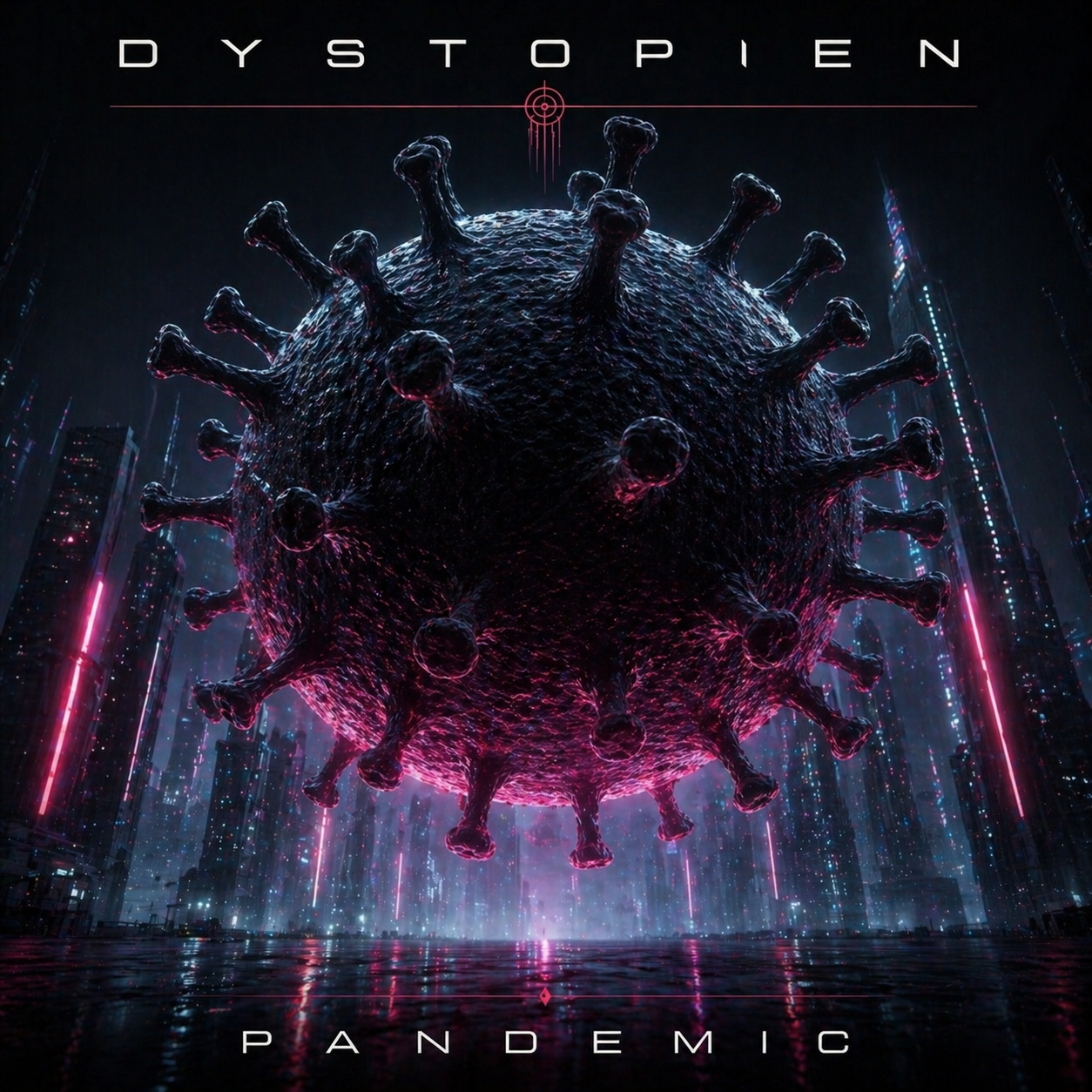
It begins with a virus. It ends with a question no vaccine can answer.
PANDEMIC is the first concept album from dystopien.de — twelve tracks, one continuous thesis, no false comfort. The album moves from the biological plane to the social, from the social to the digital, from the digital to the theological. And at the end, all four are standing in the room at once — because they were always asking the same question, just in different words.
What’s really spreading isn’t the virus. It’s the realization.
Here is what every track says — and why.
The Concept
PANDEMIC wasn’t planned as an album. It grew out of an observation: that spreading isn’t a biological phenomenon, but a universal principle. Viruses spread. Ideas spread. Systems spread. Faith spreads — and so does its loss.
Matt Leacock’s board game Pandemic, released in 2008, modeled this principle as gameplay: players cooperate against invisible outbreaks moving along travel routes and human contact. What the game teaches isn’t strategy — it’s an attitude. Systems don’t fail through malice. They fail through complexity, chance, and the cumulative weight of small errors.
PANDEMIC as an album takes this logic and applies it to everything: to the human being as a biological creature, as a social construct, as a digital identity, as a religious self-image. And in the end it asks the question it had been asking from the start — only now with nowhere left to dodge it.
01 Patient Zero — Intro
No beat. No music. A single voice.
“Patient Zero” is ground zero — the moment before the outbreak, when nobody yet knows that something has begun. The person carrying it doesn’t know. The city they walk through doesn’t know. The train they take, the handrail they grip — all normal, all ordinary, all already too late.
It is always one. It is always ordinary. It is always too late by the time anyone gives it a name.
The intro is deliberately without music — because the moment before an outbreak has no drama to it. It’s quiet. It looks like any other moment. That’s what makes it frightening.
02 Virus
The first full track states the thesis coldly and clinically: the human behaves like a virus. Not as metaphor — as description. It spreads, consumes resources, moves on.
The perspective is that of an observer with no emotional stake. No hatred, no judgment — only observation. That’s what makes the track more disturbing than any accusation.
We do not hate you. Hate requires interest. We observe you the way you observe a cell beneath a glass.
“Virus” sets the tone for the whole album: detached, precise, without comfort.
03 Batterie
The second layer of spread: not biological, but economic. The human isn’t only a virus — it’s also a resource. Its attention, its exhaustion, its loneliness get siphoned off by systems it uses every day of its own free will.
“Batterie” is the most hypnotic track on the album — because it sounds like the thing it’s describing. The pulse is steady, the beat reliable, the voice calm. Until you notice what you’re actually listening to.
Your attention is the resource, your exhaustion is the rule. You were never the consumer — you were always the fuel.
The Matrix got it wrong — it was never the body that was needed. It was the attention.
04 Unclean, Unclean
Mosaic law required lepers to call out “Unclean, unclean” so no one would come too close. The system didn’t care for the sick — it marked them.
“Unclean, Unclean” is the hardest track on the album — industrial EBM, military drums, a screamed chorus. Because the subject can’t tolerate gentleness. The song asks a theological question with no satisfying answer: if Jesus healed one and passed thousands by — what does that say about the one who decides?
Did God not see them, or did God choose to lie?
The chorus is the cry itself — “Unclean, unclean” — ending in close your eyes. God looks away. The king looks away. Society looks away. Everyone closes their eyes. It was always this way. It still is.
05 Rats & Insects
Rats above. Insects below. In between: the system that needs both and despises both.
“Rats & Insects” isn’t a left-wing or right-wing song — it’s an up-against-down song. The rat calls it merit. The insect calls it wages. In the end the system calls both the same thing.
In the end — we’re all vermin after all.
The outro delivers the album’s bitterest line: Extermination is always someone else’s idea. Until it isn’t.
06 Herd
The mass protects itself — by sacrificing the deviant. Herd immunity as a biological principle, as a political tool, as a religious structure.
“Herd” builds on three layers at once. Biological: conformity as survival strategy. Political: the mass as a manageable resource. Religious: the wolf in sheep’s clothing — Matthew 7:15 as a warning, spoken by the wolf itself.
The wolf never chases the herd. It just waits at the end of the field.
The core insight: the predator-prey system never gets abolished. It just gets renamed. Care. Leadership. Faith.
07 SINless
In the Shadowrun universe, a SIN is the System Identification Number. Whoever doesn’t have one doesn’t exist — no access to work, healthcare, housing, identity.
“SINless” is the quietest track on the album. No aggression, no screaming — just a voice whispering through concrete. The invisible make no noise. They’re simply not in the system.
They didn’t erase me. Erasing requires acknowledgment. They just — stopped updating the file.
This isn’t science fiction. It’s homelessness. It’s undocumented status. It’s digital exclusion. The Shadowrun setting makes it visible — but it’s happening today, in every city, behind every algorithm that only recognizes registered identities.
08 Corona
Corona means crown. The virus wears one — because it replicates, dominates, spreads, without consciousness, without goal. Humanity wears one too — Imago Dei, made in God’s image, self-appointed crown of creation.
“Corona” is the most poetic track on the album. Darkwave, slow, almost meditative. The verses talk about the virus in the third person. Then the tone tips — and it becomes clear this was never only about the virus.
He breathed poison into the sky and called it industry. He built cages without light and called it farming. Crowned. Chosen. Correct. Contagious. This is viral behavior.
The outro delivers the album’s strongest image: the crown of thorns. Not gold. Not glory. Thorns. And he wore it anyway. And called it divine.
09 Corporate Zone
For thirty years, when we thought of major corporations, we pictured buildings. Glass towers. Logos on façades. That’s changed.
The world’s five biggest corporations — the Glorious Five — no longer have an address. They’re systems that learn, grow, feed. Faster than regulation. Faster than democracy. Faster than the brain that trained them.
“Corporate Zone” opens danceable — synthpop, clean, seductive. Until the locusts arrive. Revelation 9: the fifth trumpet, creatures from the abyss with scorpion tails and lion’s heads. John wrote it as an end-times vision. The track reads it as a technology forecast.
The glorious five have opened wide their humongous hatches, dark inside — and what leaks out to every edge isn’t poison — it’s just the algorithm doing what it was trained to do.
The glass is very thin. It was always very thin. Nature finds a way. Code finds a way.
10 Fragile Species
No enemy. No system. No conspiracy. Just biology.
A protein molecule with no DNA of its own can wipe out the crown of creation. Without intent. Without goal. Without consciousness. It’s the most humbling version of human history — and the most honest.
You are the accident that learned to wonder, and wonder is not armor.
“Fragile Species” is the quietest, slowest track on the album. No aggression, no accusation. Just the bare fact: the human is here by chance. Not chosen. Not protected. Improbably here.
And that, in a strange way, is the most dignified thing you can say about it.
11 Pandemic
The centerpiece. The conclusion. The question the whole album has been building toward.
“Pandemic” begins on familiar biological ground. Then the second verse turns: it’s not a virus that’s spreading. It’s realization. The most pandemic substance there is — because it needs no carrier system other than a single thought, passed along.
The bridge lands the album’s final theological thesis: if the human is made in God’s image — and the human is what this album has described — then God’s work is flawed. And a flawed god is no god. Walking away from faith isn’t a decision. It’s a logical consequence.
If we are made in his image — then look at what we are. Just an animal that learned to pray to itself.
This isn’t nihilism. It’s the realization that the human is the only creature that knows exactly what’s happening to it — and keeps going anyway. Loves. Creates. Begins again.
The outro is silence. No music. No fade. Just the end.
12 Immune — Outro
Some survive. They always do.
“Immune” isn’t a celebration of survival. It’s the quiet observation that survival is no achievement. The immune didn’t earn it. The ones who fell didn’t deserve it. It was biology. Random. Indifferent. Complete.
The immune did not earn it. The ones who fell did not deserve it. There was no lesson. There was no plan.
And still: they began again. They always do. That’s the one thing the album never questions — not because it’s certain, but because it’s true. The human always begins again. That’s his virus. That’s his crown. That’s his curse, and the one thing that sets him apart from everything else.
The Album As A Whole
PANDEMIC is not a pessimistic album. It’s an honest one. It doesn’t make any diagnosis that wasn’t already known — it just refuses the usual comforts. No higher plan. No chosen species. No system that ultimately works.
But also: no ending. “Immune” is the last track — and it ends with going on. Not triumphant. Not hopeful. Simply: onward.
That’s the most human statement dystopia can make.
PANDEMIC – dystopien.com. All tracks available on YouTube. Produced with Suno.
Genre: Industrial · EBM · Darkwave · Synthpop · Coldwave · dystopien.com