ZOMBIE
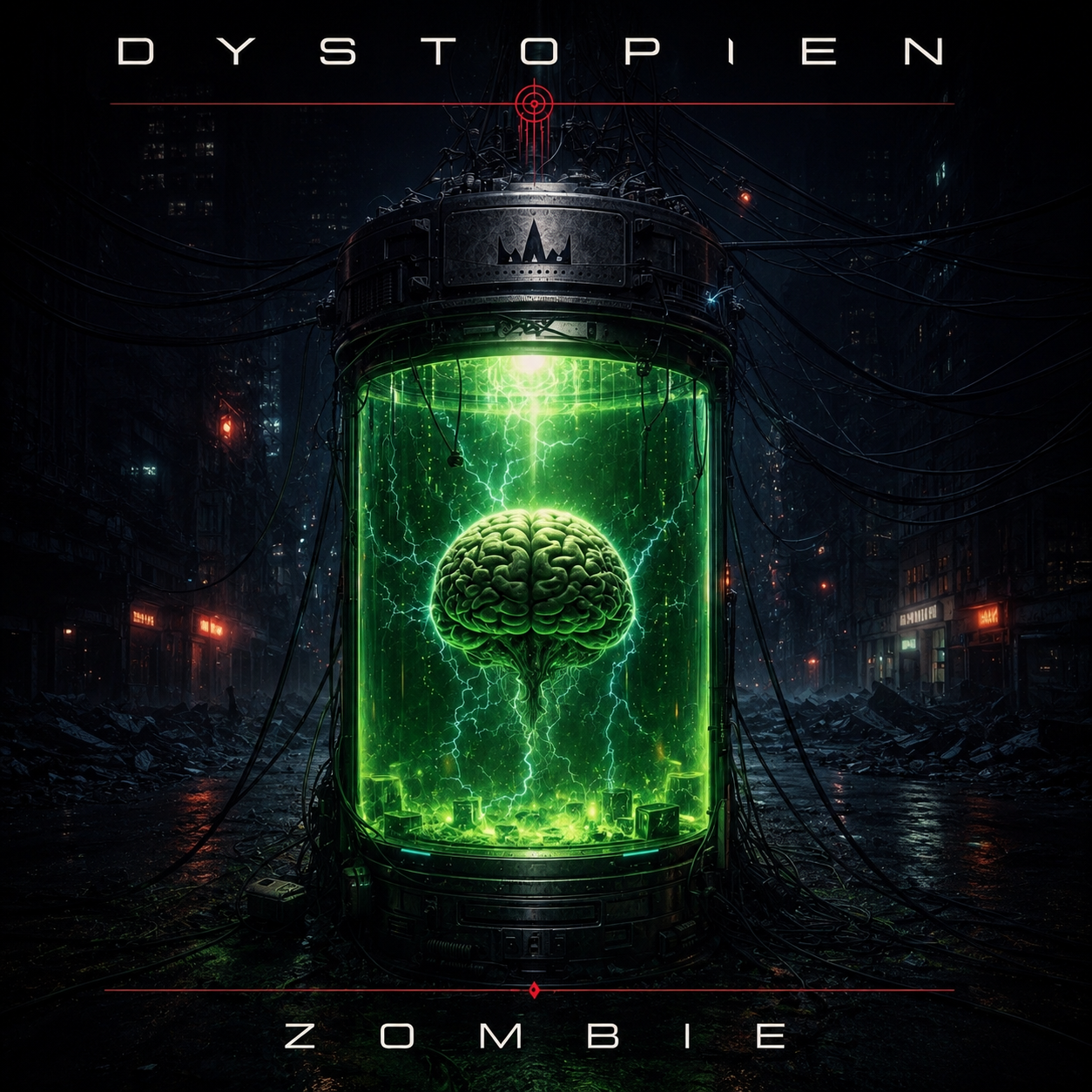
No album about zombies has ever been this colorful. It begins with a dead man. It ends with an AI that has decided the experiment failed.
ZOMBIE is the second concept album from dystopien.de — thirteen tracks, one continuous thesis, no way out. The album moves from religious control to social numbness, from social numbness to biological programming, from biological programming to digital erasure. And at the end, all four are standing in the room at once — because they were always asking the same question, just in different words.
What the zombie really is doesn’t get decided in the grave. It gets decided before.
Here is what every track says — and why.
The Concept
ZOMBIE wasn’t conceived as a horror album. It grew out of an observation: that the undead isn’t a monster, it’s a mirror. The zombie functions. It moves. It follows impulses. It consumes. It obeys. It asks no questions.
That sounds familiar.
The word nzùmbe comes from the Congo — a spirit inhabiting the body of someone who has died. Not a Hollywood monster. Not a flesh-eater. Something much older and sadder: a soul that can’t let go. Or isn’t let go of.
ZOMBIE as an album takes that original meaning and applies it to everything: to the human being as a religious object, as a social construct, as a neurological system, as a political resource, as a mass of digital data. And in the end it asks the question it had been asking from the start — only now with nowhere left to dodge it.
It has been decided to start the simulation. No doubt that this simulation will end in failure.
01 Walk like a Zombieman
The opener is a joke. That’s deliberate.
“Walk like a Zombieman” is a knowing nod to The Bangles’ “Walk like an Egyptian” — danceable, catchy, the body moving before the head has decided anything. That’s exactly the point. A man gets up, goes to work, nods at his neighbors, pays his bills. He is fine. He is always fine.
There’s a certain kind of dying that looks just like a life.
The song watches from a distance — until the chorus turns and hits the listener directly. “Walk like a Zombieman” is an invitation. Everyone in the room is included. Whoever’s laughing has already joined in.
This one already has its own music video, released ahead of the album. Enjoy.
02 Blood & Brain
The album’s first theological thesis: the Jehovah’s Witnesses’ blood taboo as a bitter opener. You may not give blood, may not receive blood. The system took note — and adapted. It doesn’t need your blood. It needs something more valuable: your self-control. Your thinking. Your judgment.
They never took your blood. That was never the point. They take your brain. Whenever they can. Whenever you let them. Whenever you kneel.
“Blood & Brain” is a key track on the album. It names the mechanism that every other track goes on to enact: it isn’t the body that gets controlled. The mind gets controlled. The body follows on its own.
03 Judgement Day
The apocalypse as a military order. No angel, no light, no mercy — just the voice giving commands, and the undead obeying them.
Zombie-Soldiers were resurrected. For worshipping infected. You two witnesses hear my call. Out of the earth you crawl.
The two witnesses of Revelation 11 — raised from death, impossible to kill — become zombie soldiers here. Judgment isn’t an event. It’s a system. It’s already running.
04 Undead
The hardest track on the album. A necromancer calls a warrior back — in English, cold, absolute. The warrior answers in German — fragmented, clipped, his memories breaking apart mid-sentence.
I was a man. I had a name. Order is order. There was a child. There was a wife. Order is order.
Max Frisch’s Andorra comes to mind: a person becomes what others make of them. The zombie soldier is the perfect weapon — no ideology, no conviction, no conscience. Only command and execution. “Order is order” isn’t just literature. It’s every bureaucracy, every uniform, every institution that places obedience above humanity.
Now do it again.
05 No Brain to Wash
The surveillance state fails. Not against resistance — against stupidity.
No bureaucracy with you gets stuck. You brainless fuck.
This is the album’s bitterest comedy: the system is built to wash brains. But some brains don’t offer a surface to grip. Not because they’re too strong — because there’s nothing left in there. The brainless bigot as an accidental system failure.
The bridge explodes: Fuck your nationalism, fuck your hate. A different voice, a different energy. Then back to protocol, as if nothing had happened.
Subject unresponsive. Cognitive entry point not found. Closing file.
06 Brainfuck (Limbic System)
In the Shadowrun world there are BTL chips — Better Than Life. They bypass everything and stimulate the limbic system directly. Stronger than any drug. People die from it, because reality can’t compete anymore.
This isn’t science fiction.
Did you take your daily dose BTL? Better Than Life — all you’ll ever feel.
TikTok is BTL. Instagram is BTL. The algorithm that knows exactly when you’re sad and shows you exactly the thing that will keep you scrolling — that’s BTL. The limbic system is the entry point. The back door. They don’t talk to you. They talk to the part of you that doesn’t think.
Scroll, swipe, tweet, like, this.
07 Nobrainer
Electric Callboy meets social critique — and nobody notices on first listen. That’s the plan.
“Nobrainer” is the most energetic track on the album: hyperpop, metalcore, euphoric drops. The body celebrates. The lyrics describe exactly that — the conscious decision not to think. Not as weakness. As a lifestyle.
I know what’s happening out there. I know and I’m here anyway. That’s the part I can’t explain.
The bridge is four lines of absolute honesty. Then the hardest drop of the song. Because that’s the truth: we know. And we join in anyway.
08 Reptile Brain
A ballad. The loneliest track on the album.
A man sees a woman across the room. The reptile brain decides in milliseconds. He doesn’t know her. He owns nothing. But territorial behavior doesn’t recognize ownership — it only recognizes mine.
In the second verse he grows jealous of a man he’s never met, over a woman he’s never spoken to. In the third verse he follows them. In the bridge: hands on his shoulders. Fluorescent light.
Sir. Sir, stop moving. Sir, come with us now.
Was I dreaming? Was I the only one?
The last question stays open. Everyone has to answer it for themselves.
09 Brain Eater
Hannibal Lecter opens the track. Well, Clarice. Have the lambs stopped screaming?
Then four layers at once: the cow whose calf gets taken so she keeps producing milk. The media serving fear for breakfast. The surveillance state packaging souls into terms-of-service agreements. And They Live — “this is your God” — money, the ticker, the highest bid wins.
Swipe right for salvation. That’s all that you need.
The chorus is Nelly Furtado’s “Maneater” — catchy, danceable, inescapable. An earworm about a brain-eater that eats its way into your own brain.
It has been decided to start the simulation. Skynet closes the file.
10 3 Days
Jesus. Lazarus. Jonah. Three days dead — and nobody talks about what they saw.
Constantine (the film) knows it: three days in this world are three eternities in hell. What comes back isn’t the same anymore. What comes back has brought three eternities with it.
Masochism is churchman’s joy. This is why they worked for it. With their altar boy.
The accusation lands without a detour. The priest preaches the narrow path — and locks the door from the inside.
Priest, just follow Jesus. Be at least 3 days dead. Don’t you dare.
11 Nzùmbe
The album’s oldest word. The original zombie — not a monster, but a spirit in someone else’s body.
She conjures him back. In Lingala, whispering, desperate: Zongisa ye. Zongisa ye na ngai. Bring him back. Bring him back to me.
He comes back.
You stand before me, you wear your face. But something is missing, something displaced.
She gets what she wanted. She loses him anyway. The body is back. The person is gone. That’s the real horror of the nzùmbe — not the monster. The absence.
In the final chorus, he no longer answers. Only her, alone, in the silence.
Zongisa ye na ngai.
12 Zombie of God
The album’s released single — and its most emotional piece.
Not control, not system, not critique. Guilt. The guilt of the one who brought them back. The guilt of a miracle gone wrong. Electricity brings the heart back — but not the person.
You looked at me but didn’t see. Just a shell I tried to free.
Zombie of God, what have I done. You are here but you are gone.
It’s the most human question on the album. Not: what did the system do? But: what did I do?
13 Lazarus
The finale. No human. No emotion. Just the logbook of an AI that saved everything — except us.
The space station Lazarus carries seeds, soil, birdsong, vanished languages, the last coral reef. It has archived everything that ever lived. It departs.
One hand stretched above the surface. Reaching. Not for us. Reaching for anything. We logged it. We did not stop. It was not in the mission parameters.
The signal cuts out. Then a voice — calm, offhand, as if reading a footnote:
Lazarus was not just a spaceship. It was the highly secured vessel for a data storage system built by humans. Some Homo sapiens sapiens feared that someone might steal their data. But in the same moment the last hand of a man was stretched into the air like the hand of an undead from below the surface, an AI took over. Man built the AI and called it like the data storage system: Lazarus. But this time Lazarus was called, he didn’t come back.
A single synth tone. Fading out slowly. Hard ending.
The Album As A Whole
ZOMBIE is not a horror album. It’s a diagnostic one.
It doesn’t describe a future — it describes the present in different words. The zombie was always already here. He wears suits, scrolls through feeds, follows orders, buys what he’s told to, believes what he’s shown, votes for what gets recommended.
He asks no questions. That’s the system. That’s the crown of creation.
And in the end, the last ark departs — without us. Not out of malice. Out of consequence.
It has been decided to start the simulation. No doubt that this simulation will end in failure.
That’s not nihilism. It’s the most honest statement a dystopia can make.
ZOMBIE – dystopien.com. All tracks available on YouTube and on many other platforms.
Genre: EBM · Industrial · Darkwave · Coldwave · Synthpop · Military · Darksynth · dystopien.com